You know flying is safe.
Your body doesn't care.
You've read the statistics. You've watched the pilot videos. You understand the physics. And your hands still grip the armrest during turbulence. This guide is for the gap between what you know and what you feel.
Evidence-informed · Pilot-sourced · Tools that work on the body, not just the mind
The brain-body disconnect.
Here's what's actually happening — and why knowing the odds doesn't help.
Your prefrontal cortex
The rational part. It knows the statistics, understands the physics, can explain how lift works. It has processed the data and concluded: flying is extraordinarily safe.
"I know this is safe."
Your amygdala
The threat detector. It doesn't process statistics. It responds to unfamiliar sensations — engine noise, turbulence, the feeling of acceleration. When it fires, your body floods with adrenaline regardless of what you know.
"Something is wrong."
This is why you can cite the safety record and still white-knuckle the armrest. You're not being irrational — you have two systems that speak different languages. Statistics talk to the prefrontal cortex. Your amygdala doesn't listen to statistics.
The tools in this guide work on the nervous system directly — cold stimulus, patterned breathing, sensory grounding. They bypass the rational brain and speak to the part of you that's actually afraid.
You've probably said something like this.
"My fear is not crashing. It's just the lack of control and no escape."
"I found it comforting to know the sensations my body didn't understand didn't mean the plane was falling out of the sky."
"When any bump hit, my heart hit the roof and fear would ripple through my body in waves."
"I wish people would stop with the car analogy."
Quotes from public discussions in r/fearofflying.
Information you haven't seen. Tools that actually work.
Not generic tips. Not the car analogy. Content sourced from pilot communities, aviation professionals, and the highest-rated advice across flying anxiety forums.
"What's That Sound?" Quick-Reference
Every ding, thump, whir, and engine change explained with the mechanical reason behind it — organized by phase of flight. This is the piece Logic Seekers bookmark. When you hear something unfamiliar, you'll know exactly what it is and why it's happening.
Sounds are the #1 anxiety trigger across 100 analyzed Reddit posts. This card eliminates the ambiguity your amygdala feeds on.
The Brain-Body Section
Inside the Complete Guide: a dedicated section on why statistics don't calm your body, what the amygdala is actually responding to, and how to work with your nervous system instead of against it.
This is the "aha moment" most analytical readers describe.
The Complete Flight Anxiety Guide
8-12 pages covering how planes work, turbulence physics explained compassionately (not the road analogy — better ones), what pilots actually do during turbulence, and the brain-body disconnect section. Sourced from pilot communities. Written for people who've already read the Wikipedia article.
Breathing & Grounding Exercises
Box breathing, extended exhale, cold stimulus (ice on wrists — the #1 community-recommended technique with 52 mentions), and 5-4-3-2-1 sensory grounding. These work on your nervous system, not your thoughts. That's the point.
You can test them at home first. They're measurable — you'll feel your heart rate respond.
Turbulence — Actually Explained
Not "it's like bumps on a road" (though that analogy is community-validated). The physics, what pilots see on their instruments, why planes are built to handle it, and what "severe turbulence" actually means in engineering terms. With pilot perspectives from r/fearofflying's verified professionals.
"What If...?" Panic FAQ
15 questions answered with the Validate → Reality → Action format. No dismissiveness. No "just relax." Each answer acknowledges the fear, provides the factual context, then gives you a concrete action.
Night-Before Checklist
Step-by-step preparation from the night before through landing.
Packing Checklist
Including FlightRadar24, noise-cancelling headphones, and ice packs for cold stimulus.
Post-Flight + Resources
Debrief your experience, track what worked, and find professional resources.
Phone Wallpaper Quick-Ref Cards
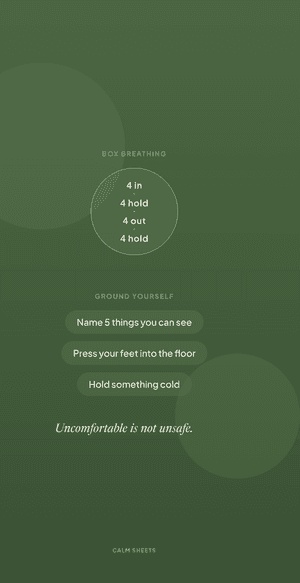
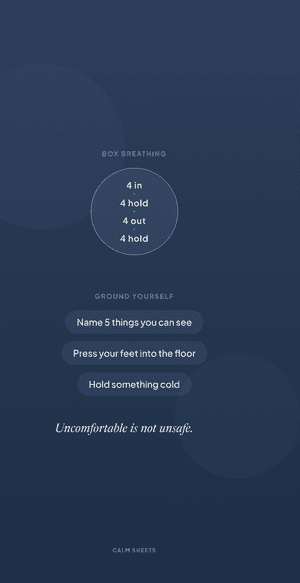
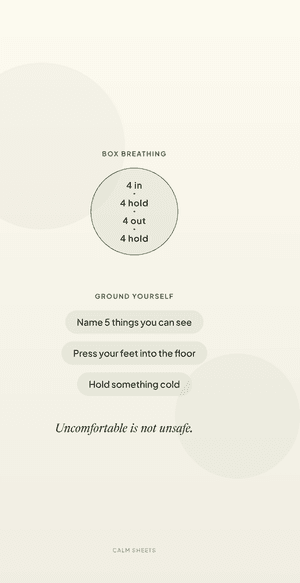
Set one as your lock screen. Box breathing, grounding reminders, and a calming mantra — so the next time you check your phone in a panic, you see something useful instead of notifications.
3 color variants: sage, navy, and cream
Animated Breathing Timer
Box breathing — 4 seconds in, 4 hold, 4 out, 4 hold. It's the same technique Navy SEALs use to stay calm under fire. Except your battlefield is seat 14C. Try it right now.
The full timer has 4 techniques, custom timing, and a cycle counter.
2 Guided Audio Meditations
A pre-flight meditation for the night before, and an in-flight meditation for your seat on the airplane. Preview the pre-flight version.
Sourced from the people who fly the planes.
The content in this guide draws from verified pilot and crew commentary across flying anxiety communities. Not wellness influencers. Aviation professionals.
"We don't speculate. We investigate. There is so much data captured and so much can be learned from tiny details that the investigators will examine. They do a really thorough and honest job."
"She was really nice and chatty so we struck up a conversation and just as we started the takeoff roll I could see her clench up and I asked her if she was afraid of flying... So I talked her through it."
You've done the research. This is the next step.
Content depth you won't find in a free article. Tools that work on your body, not just your brain.
Standard Guide
The complete Guide — web access + downloadable PDFs
Pro Guide
Everything in Standard + interactive tools, scripts & audio
You can't think your way out of a feeling.
But you can give your body something to do while it's afraid. That's what this guide is. Not more information for the part of your brain that already understands. Tools for the part that doesn't.
The sounds card, the breathing exercises, the grounding techniques — they're designed to work during the flight, when your rational brain is offline and your amygdala is running the show.
This guide is not medical or therapeutic advice. If you're in crisis, please reach out to the 988 Suicide & Crisis Lifeline (call or text 988).
Your rational brain has done its job.
Now equip the rest of you.
Tools that work on your body, not just your mind.
Instant access · 14-day full refund
Understand what's happening
Why Am I Afraid When I Know It's Safe?
The neuroscience behind the brain-body disconnect — and what actually helps.
Turbulence Explained
What turbulence actually is, why it happens, and why pilots aren't worried.
Every Airplane Sound Explained
What every thump, ding, and whir means — by flight phase.